THE HOLY BYZANTINE CATHOLIC ORTHODOX CHURCH INC
A TRADITIONAL COMMUNITY
|


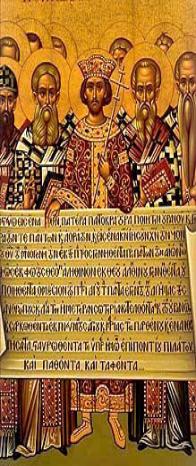
The First Ecumenical Council
This Council was held in Nicea, Asia Minor in 325 A.D. at the instigation of the Emperor,
Constantine the Great. 315 Bishops were in attendance.
The Emperor called the council due to the raging Arian Controversy at that time.
Arius denied the divinity of Christ, based upon his supposition that if Jesus was born,
then there was a time when He did not exist. "If He became God, then there was time
when He was not (God)." The Council declared the teaching of Arius to be heresy,
decreeing that Christ is God and declaring Him to be of the same essence
homoousios with God the Father.
The first part of the seven articles of the Creed, known to us as the Nicene Creed,
were ratified at this First Ecumenical Council
The Second Ecumenical Council
This Council took place in Constantinople in 381 A.D., under the reign of Theodosius
the Great. 150 Bishops attended.
Its purpose was to determine a solution to what was called the Macedonian
Controversy. Macedonius misrepresented the Church's teaching on the Holy Spirit. He
asserted that the Holy Spirit was not a person hypostasis, but only a power dynamic of
God. Consequently in his interpretation, the Holy Spirit was inferior to the Father and
the Son. The Council condemned his teaching and defined the doctrine of the Holy
Trinity, decreeing that there was One God in three persons hypostases: these persons
being the Father, the Son, and the Holy Spirit.
The holy fathers at the Council added five articles to the Creed: beginning, And in the
Holy Spirit, the Lord, the Giver of Life...
The Third Ecumenical Council
Held in Ephesus, Asia Minor in 431 under Emperor Theodosius II (grandson of Theodosius
the Great). 200 Bishops were present.
It concerned the nature of Jesus Christ, the Second Person of the Holy Trinity. Nestorius
taught that the Virgin Mary birth to a man, Jesus Christ, not God the Logos ("The
Word", Son of God). Following this reasoning, he asserted that the Virgin should not be
called Theotokos (Mother of God), but rather, but rather Christotokos (Mother of
Christ).
Nestorianism over emphasized the human nature of Christ at the expense of the
divine. The Council denounced Nestorius, emphasizing the our Lord Jesus Christ is one
person, not two separate people:
(1) the man, Jesus Christ and
(2) the Son of God, Logos. He is complete God and complete man,
with a rational soul and body. The Virgin Mary is Theotokos because
she gave birth not to man but to God who became man.
This Council declared the test of the Creed decreed at the First and Second
Ecumenical Councils to be complete and forbade any change to it.
The Fourth Ecumenical Council
The Council of 630 Bishops met in Chalcedon, near Constantinople, under the Emperor
Marcian in 451 A.D.
The Council was concerned with the Monophysite Controversies, again dealing with
the nature of Christ. Monophysite teaching believed that Christ's human nature (less
perfect) dissolved itself in His divine nature (more perfect). Thus, as they reasoned,
Christ had only one nature, the divine. This led to the term Monophysite
(mono),meaning 'one', and physis, meaning 'nature'. The Council condemned this
theological theory, proclaiming that Christ has two natures: the divine and the
human, as defined by previous Councils. They are not confused, or divided, or
separate and were in no way ever changed.
The Fifth Ecumenical Council
The Council of 165 Bishops met in Constantinople in 553 A.D., during the reign of the
Emperor Justinian.
The key issues were the Nestorian and Eutychian (Monophysite) Controversies. The
Council was called in hope that it would put an end to this wrangling within the
Church. It confirmed the Church's teaching regarding the two natures of Christ and
condemned a number of Nestorian influenced writings. At this Council, the Emperor
himself confessed his Orthodox Faith in the form of a famous Church hymn, "Only
begotten Son and Word of God".
The Sixth Ecumenical Council
Convened in Constantinople, under Emperor Constantine IV, in 680 A.D., 170 Bishops
met to deal with the Monothelite Controversy.
It was a final attempt to compromise with the Monophysites. They claimed that
although Christ had two natures (human and divine), He nevertheless acted as God
only, i.e. His divine nature made all the decisions and His human nature only carried
and acted them out. Thus, monothelitism ( mono, meaning 'one' and thelesis,
meaning 'will').
The Council pronounced that Christ had two natures with two activities:
as God - performing miracles, rising from the dead and ascending into
heaven; as Man - performing the ordinary acts of daily life.
These were mystically united in one Divine Person of our Lord and Savior Jesus Christ.
The Seventh Ecumenical Council
This Seventh Council of 367 Bishops returned, in the year 787 A.D., to Nicea in Asia
Minor, at the royal pleasure of the Empress Irene.
It centered on the Iconoclast Controversy, the use of Icons in the Church. The
Iconoclasts were suspicious of religious art. They demanded that all such art be
removed from the churches and destroyed. They were opposed by the Iconophilles
who believed that Icons served to preserve the doctrinal teachings of the Church.
They saw this art as an expression of the divine.
The Council ruled that Icons should be exhibited in churches. They further defined that
"whenever these representations are contemplated, they will cause those who look at
them to commemorate and love their prototypes. They are to be an object of
veneration and honor, but real worship is reserved for Him who is the subject of our
faith, our God, Father, Son, and Holy Spirit.
@2005 by The Holy Byzantine Catholic Orthodox Church inc.
All right reserved